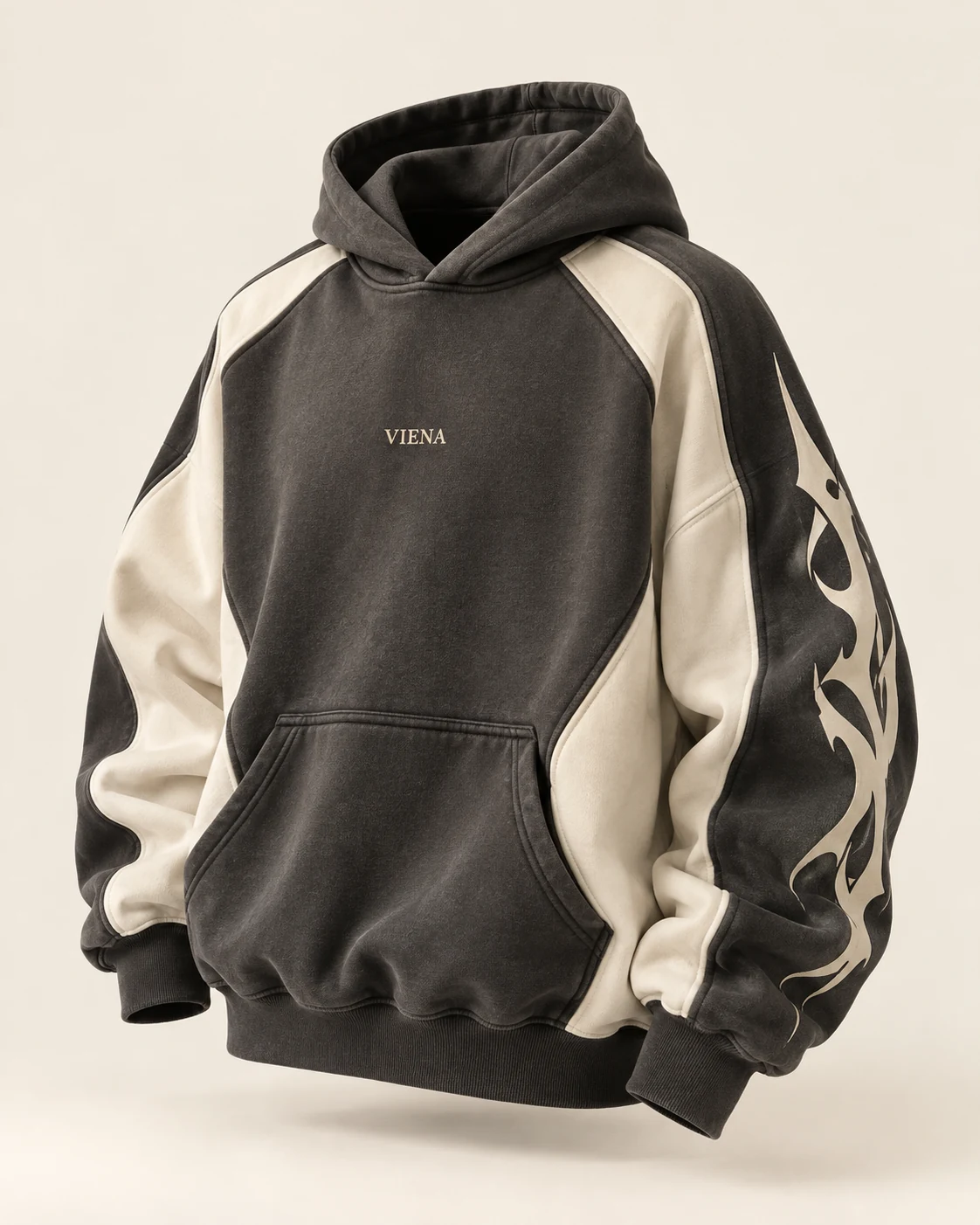
Colourblocking gives a hoodie a visible design signature before any artwork is added. It also changes the cutting plan because each panel needs an agreed fabric colour and direction.
VIENA FACTORY develops samples and manufactures garments for this product direction through our specialised production units in Vietnam.
Start with the garment and fabric
For a heavyweight brief, compare brushed fleece and French terry around 360–420 GSM. Confirm that contrast colours have compatible weight, stretch and wash behaviour. A visually balanced sketch can still produce an uneven sample if the materials behave differently.
Brushed fleece, French terry and rib
Nỉ bông is the brushed-fleece direction, while nỉ chân cua refers to a loop-backed French terry direction. Discuss 360–420 GSM as a development target where suitable and review the inside surface physically. Specify rib cuffs, necks and waistbands separately. Confirm composition, shade and wash behaviour on the sourced material rather than inferring them from a concept image.
Build a reasonable price around a clear brief
Reduce the first run to the panels that matter most. Ask for separate quotations for two-colour and three-colour versions, with identical trims and decoration. Material availability and the quantity assigned to each colour should be settled before promising a launch date.
Develop 1–2 pieces per style before bulk
Inspect panel intersections, seam bulk and left-to-right symmetry. Check whether the colour joins stay balanced when the hoodie is worn. Approve the placement of the sleeve graphic on the actual assembled sample, not only on a flat drawing.
Control colourblock hoodie risk at the panel joins
Contrast panels are not just a colour choice. They affect cutting allocation, seam intersections and the chance that unlike materials distort after care. Label each panel on the technical drawing and identify which material code it uses. Compare light and dark panels for colour transfer where relevant. Fit the hoodie with its hood down and up to ensure seam placement has not created an awkward pull. Keep the first approved colour combination as the reference before adding more variations.
| Decision | What to review | What to agree |
|---|---|---|
| Panel map | Number panels and identify fabric direction/material codes. | Review left/right symmetry on the sewn body. |
| Wash compatibility | Check contrast joins and shade transfer. | Agree a care review for the full combination. |
| Cost control | Separate two-colour and more complex panel options. | Retain essential fit details before removing construction steps. |
Can two fabrics with equal GSM be combined without testing?
No. Equal weight does not establish equal stretch, shrinkage or colour behaviour. Approve the assembled contrast sample.
Continue your product development
For the next decision, read Fleece Colour Matching for Hoodie and Pants Sets, compare Pullover Hoodie Manufacturing: A Streetwear Fit Brief, and use Fleece Jacket Pockets and Panels: A Sampling Checklist to complete the brief.
Send a brief that can be quoted
- Product reference, front/back artwork and a measurement guide.
- Preferred fabric construction, composition, weight and finish.
- Sample quantity, planned bulk quantity and size/colour split.
- Brand labels, packaging requirements and shipping destination.
Request a project quotation or email tomvo@vienafactory.com. Explore VIENA Streetwear concepts and fabric development options while preparing your first brief.